 KUKŪ
Activities for 4-year-olds
Games for 3 and 4 year olds: 6 no-prep activities
Games for 3 and 4 year olds need only a few everyday objects and one clear rule: count toys, compare towers, match pairs or tell a story in three pictures.
1. Count toys between two houses
Set out two boxes or draw two squares. Your child puts one toy animal into each house. Then add one more animal and ask where there are more now. If your child doesn’t see it, line the toys up in parallel rows so you can see which one is left without a partner. If they are still interested, ask them to make the groups equal. A 3 year old can simply put one toy in each house; a 4 year old can try adding and comparing.
You can swap the animals for large blocks or find as many spoons as the family needs for dinner. Ask your child to show which objects they mean when they say “three”. If they point to one, count together and finish by sweeping your hand around all three. You will find more examples like this in our article on how to teach a child to count.
2. Build two different towers
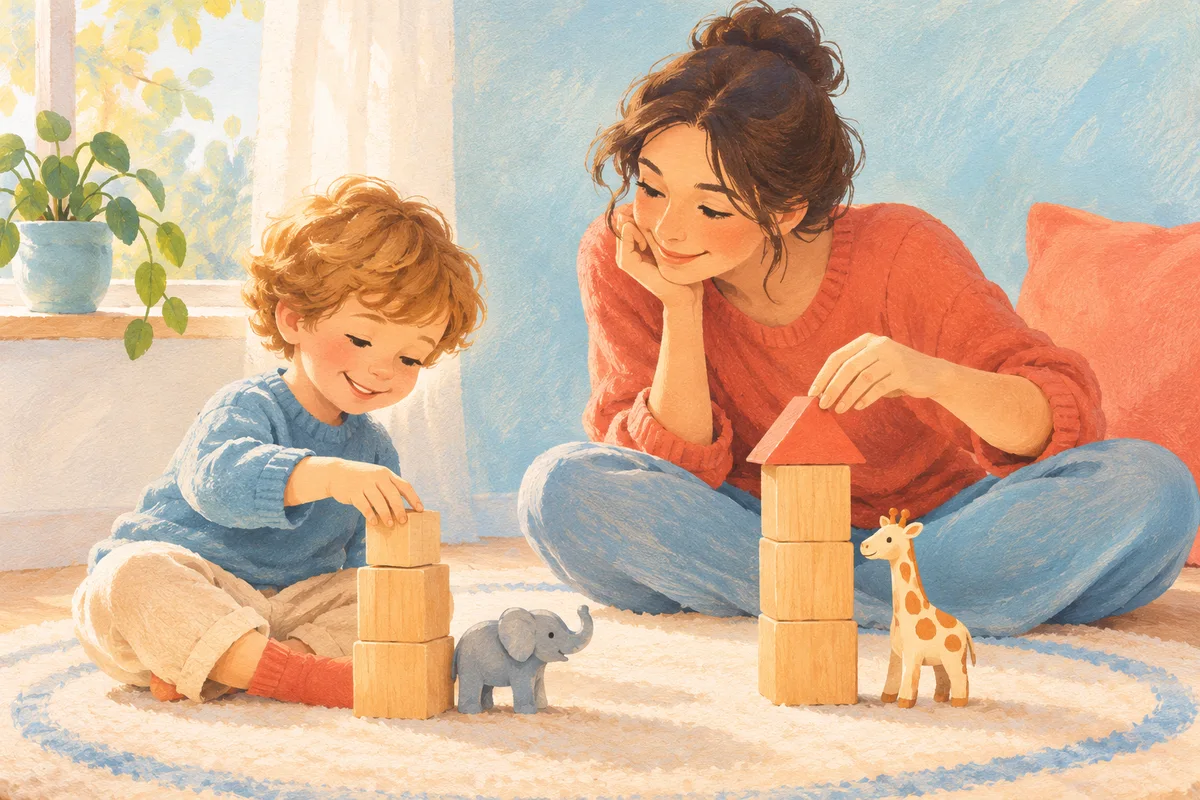
Using a few blocks of the same size, build a tall tower and suggest your child makes a shorter one. Then swap roles. If your child would rather build a house, agree to build two houses and compare their height. Put the two buildings on the same surface so that you can compare them.
Later try towers made of different blocks. A shorter tower is sometimes made of more blocks than a taller one. Ask what the difference is between height and the number of blocks. If your child is curious, hold a ruler above both buildings or lay the towers down side by side. When comparing doesn’t appeal, it is enough to build and let the animals move in.
3. Find the pair from a clue
Mix up two or three pairs of socks. At first look for matching socks turned the same way. Then hide one pair under a towel and invite your child to remember its colour or pattern. It helps to start with very different pairs. If both are blue, point out the stripes or spots. Two-year-olds may enjoy just matching two very different socks.
For a child who doesn’t feel like sorting, hand over one sock and suggest finding its friend. If they bring the wrong one, ask how the two are alike. Perhaps they are the same size even though the colours differ. Agree which feature matters this time, and let your child ask you the same question.
4. Tell your day in three pictures
Pick a familiar activity, such as going out. Draw or find three simple pictures: shoes, door, tree. Put them in the order things happen. Your child can move one and say what you would need to do first. If their order makes sense, ask them to explain how it works.
In the evening you can make a sequence of pictures from what you actually did. One of you draws, the other tells the story. If your child isn’t yet interested in three pictures, keep two and ask just one question. Next time they can choose the activity: making pancakes, dressing a toy or watering a plant.
5. Play “bring me what I describe”
Say “Bring me something soft” and choose a safe, easy-to-reach place. Your child might find a pillow, a jumper or a toy. If it suits everyone, talk about what else in the room is soft. Later add a second clue: “Bring me something soft and blue.” Sometimes it is easier to ask your child to point instead of fetching.
If they can’t find anything, make the search area smaller, for example one shelf. When your child wants to be the leader, let them think up their own challenge. It can be a silly one. Something that is red and can jump might remind you of a toy frog; check together when you see what your child meant.
6. Try out different voices in a story
Pick one short sentence, such as “May I come in?” Say it the way a shy hedgehog at the door would. Then try the voice of a little bear or a cheerful rabbit. Your child can guess the character or change the voice themselves. If they don’t want to act, choose a book and talk together about which character is speaking.
Afterwards, if your child wants to, try one similar task on screen. The KUKŪ educational games, voiced in English, include number, letter, colour and memory activities. Pick one category first and see whether your child likes it, rather than trying to get through them all in one go.
How to start when you only have five minutes
Choose an activity that fits what you are already doing. While making breakfast, compare two unbreakable cups: which is taller and which has more spoons in it? If your child wants to take on one part, hand over the spoons. You can do the other steps yourself and briefly say what you noticed. A few minutes are enough for one comparison.
If a task is too easy, don’t change it completely. For example, when your child has found one pair, you can suggest finding an object that is different from it. If it is too hard, start with an example and let your child decide the last step. In the first few tries it is more useful for them to feel they want to carry on than to complete every part you planned.
Ask another family member to repeat the rule the way your child understood it. Two or three lines on the fridge can serve as a reminder: “We build towers. We compare which is taller. Then we count the blocks.” Next time it will be easy for your child to choose which of those parts they would like to take over.
Frequently asked questions
Should every 3 or 4 year old be able to do all of these?
These are optional game ideas. For each activity you can reduce the number of objects or play together, which makes most of them work for a 3 year old too. One child may love towers, another acting. Pick the first game by your child’s interests and set the pace to suit them.
How many activities should we offer in a day?
One is enough. If your child wants to keep playing, it is good to repeat the same rule with another object. It is worth finishing an activity while it is still fun. You can come back to the other ideas whenever your family has a spare moment.