 KUKŪ
Mazes
Mazes for kids: 4 ways to play at home
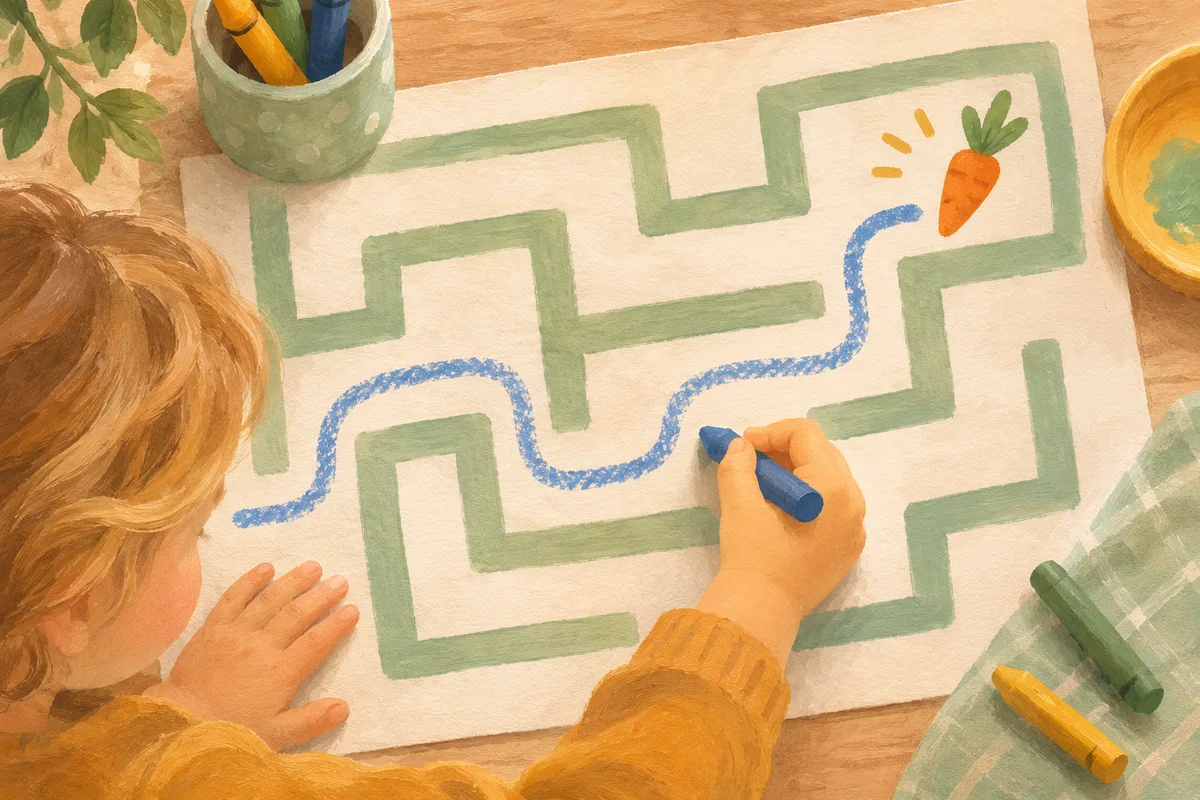
The simplest maze for kids fits on one sheet: draw a wide path with two turns, mark the start and draw a goal. Let your child trace it with a finger.
1. Draw a first maze on paper
Start with a clear goal: the rabbit has to reach the carrot, or the car has to reach the garage. On a blank sheet, draw two parallel lines with one or two turns. Leave enough room between them for your child to trace comfortably with a finger. Then add one side branch that ends in a closed wall. On another sheet you can turn the same puzzle round so the start is at the top.
Trace the first path yourself and say what you’re doing: “This way is closed. I go back to the turn and choose the other.” The second time, leave your child’s hand free. If they cross a line, there’s no need to start over or fix every mark. What matters is noticing where they can carry on. If the paper slides about, hold down a corner while they try.
2. Move the maze to the floor
On a non-slip rug you can make a wider path from soft objects that are easy to move. For example, lay several cushions along the edges and put a favourite toy at the end. Leave enough room to turn round. Show where to start and invite your child to walk the path carefully. When you’ve tried it, swap: your child lays out a path with objects and you look for the end.
If there are two of you, one can be the guide. The guide says or shows where to turn, and the other moves. For a child still learning “left” and “right”, it’s easier to say “towards the window” or “towards the sofa”, or to point. Mark one turn with a bright cushion. Later, try saying what happens when you come back the same way.
3. Copy the path on a grid
Make two identical grids of nine squares. On the first, draw a path through three neighbouring squares, for example from the bottom up and then sideways. Mark the start with a dot. On the second grid, your child can copy the path with large blocks or a pencil. At first, leave the original on the table. If your child wants a challenge, cover it for a few moments and let them look again if they need to.
When they succeed, give your child the sheet with the first grid. They can make up a path for you. Ask whether you’re allowed to cut across a corner. If you’re only moving along shared edges, show that on the paper. When a grid path gets very long, you don’t need a bigger sheet. Instead, try the same path from a different corner. You’ll find more tasks that involve remembering or copying a pattern in the KUKŪ educational games.
4. Turn a walk into a path
After a short walk, remember two or three things you saw. Draw a house, a big tree and a shop. Draw several paths between them. Agree on what order the character will visit them in. If they have to reach the tree first, don’t let the shop sign appear earlier. While you draw, your child can remind you where you actually turned.
This activity can end with your child’s own map, which doesn’t have to match a real street plan. The next day they can add a stream or a friend’s house to the drawing. What matters is that you can get from the start to the goal along at least one path. Let your child check for themselves whether their map works.
How to choose the difficulty, and when to stop
At first, leave one dead end and lead straight to a visible goal. After that you can add a new turn, a longer path or another marker. Change one thing at a time so your child has time to see what’s new. If their hand is tired or they need to concentrate harder, go back to tracing with a finger. They’re still solving the same puzzle, just in a more comfortable way.
A maze can also be a shared drawing. One player draws a turn, the other continues it and hides the exit somewhere unexpected. At the end, swap sheets and try to find the exit the other made. One attempt is enough, and you can keep the rest of the sheets for another day.
A simple maze you can draw right now
Draw three rows of squares and three columns. Mark the start in the bottom-left square and put the carrot in the top-right one. Draw a wall between the middle square in the row and the square directly above it. Now you can climb from the bottom up the left or the right side, but you can’t cross the wall. Ask your child to show at least one path, then look for another together.
If you want a clearer start, shade in a few squares that can’t be entered. Leave an unbroken open path. The rule itself can be said aloud first: “We move along a shared edge. Is there a wall between us and the next square?” This check is easy to adapt on the floor, with sheets of paper instead of squares.
Before you give your child the sheet, walk the path you’ve drawn yourself. If you’ve accidentally closed the exit, fix one wall, or decide that your child has to find where the gate should be opened. When you come back the next day, you can start from the old finish and lead the character home. Change the start and the same drawing becomes a new puzzle.
If you each found a different path, colour them in different colours and count how many turns each one makes. You may notice that the shorter path has the same number of turns. For a child who finds counting hard, suggest putting down a block for each turn and comparing the two rows. If the paths are the same length, let them choose the one the rabbit would prefer, and say who it might meet there.
Frequently asked questions
Do I have to print a maze?
No. A blank sheet and a thick pencil are enough. You can also build a maze from large blocks and lead a toy along the path.
What if my child keeps turning into the dead end?
Show that you can go back to the previous turn. Your child can leave a mark there to remember where they’ve already tried. If needed, start with a shorter path or point to both ways together with a finger. Later, ask your child to draw one dead end for you.